
Showing posts with label historical. Show all posts
Showing posts with label historical. Show all posts
Thursday, 13 July 2017

Thursday, 21 January 2016
Author Interview: Juli D. Revezzo

About the Author:
Juli D. Revezzo loves fantasy and Celtic mythology and writing stories with all kinds of fantastical elements. She is the author of The Antique Magic series and the Paranormal Romance Celtic Stewards Chronicles series, New Adult romance Changeling’s Crown, and many short stories. She is also a member of the Independent Author Network and the Magic Appreciation Tour.
Do you plan everything or just let the story flow?
Hi, Annette, thanks for having me. Let’s see…. I plan my stories a little, but I like to let them do what it will. If I plan too much, the writing seems to stop.
Do your characters ever want to take over the story?
All the time! :)
What is your favourite food?
I’m like Garfield. I love lasagna, all Italian food, really, but lasagna’s a favorite. :)
Are you a morning person or a night owl?
I’m more of a night owl, these days. I seem to do my best writing after, at least, 2pm.
Where do you dream of travelling to and why?
Ireland. I’ve always wanted to see the Emerald Isle. I’d love to see the landscape that ties into my books (Druid Warrior’s Heart specifically) firsthand. - go, it's beautiful, but I may be biased ;)
Do distant places feature in your books?
Yes. The heroine of Druid Warrior’s Heart owns/is keeper of a battleground sacred to the gods, in a small area of Ireland. (They later move to Florida, but that’s a different era and book :)) I know I couldn’t go see what her area looked like in the 16th century, when Druid Warrior's Heart takes place, but still, I'd love to visit the island.
Do you listen to music while writing?
It depends. While I’m writing the first draft, yes, for the most part. When I’m editing, I find I can’t.
Could you tell us a bit about your latest release?
Druid Warrior’s Heart continues my Celtic Stewards Chronicles fantasy romance series. The series follows a family, and Druid Warrior’s Heart specifically, goes back to the next generation. The steward this time, Ruth Macken, lives in Ireland in the 16th century. She knows—or rather, has been taught—that a group of mythic, sacred warriors from the Tuatha dé Danann will arrive one day, and ask to use her land to stage yet another round of battles against their evil foe Balor who intends to destroy the Earth, and all Ruth has come to know and love. With them will come a guardian who will protect her from Balor’s nefarious plots, and with whom she’ll fall in love.
What have you learned about writing and publishing since you first started?
A whole lot! It’s easier—and harder—to do things myself. Promotion sometimes takes up as much time as writing (or more!). Plus, I know my writing has improved, from where I started out all those years ago.
Is there anything you would do differently?
I would say, I’d probably start seeking publication earlier than I did, but then again? It might’ve been good that I waited until after high school to begin sending stuff out. Who knows?
Who, or what, if anything has influenced your writing?
A fantasy author named Michael Moorcock influenced me in my early days. Also, especially for Druid Warrior’s Heart, the medieval authors. I can also point to several indie authors, some who are friends who keep my stubbornness plugging along.
Anything you would say to those just starting out in the craft?
Read widely. Keep learning, keep trying, and if you believe in your work enough, don’t let anything stop you.
What are three words that describe you?
Tenacious, creative, dreamer.
What's your favourite book or who is your favourite writer?
As I said above, my favorite writer is Michael Moorcock. I also have enjoyed H.P. Lovecraft, Laurell K. Hamilton, Robert Silverberg, Melanie Rawn, Jolene Dawe, Suzanne G. Rogers, Elizabeth Moon., Virginia Woolf. The list is endless… Same thing with books. There are just too many to list, but I am currently enjoying The Lunatic Café by Laurell K. Hamilton, and The Mannequin, an historical romance by Suzanne G. Rogers.
Blurb of your latest release or coming soon book.
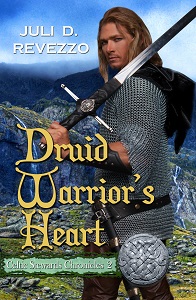
As the latest in her family’s long line of stewards, Ruth Macken awaits the arrival of a warrior sworn to the Tuatha dé Danaan, the Celtic gods her family has served since the beginning of time. For on that day, a magical battle will erupt. A war between druids and an evil that will decide the fate of mankind.
Isaac Connel knows the battle is imminent, and is ready to fight, once again but from the moment he sees Ruth flitting around the sacred ground, he’s captivated by her fiery charms and a need to protect her.
Despite Isaac’s assurances and the dreams that guide her, what can Ruth and her lover do to drive off this evil? Despite everything, will the world end at the hands of an evil god?
Your readers can find it available at Amazon:
http://www.amazon.com/Druid-Warriors-Celtic-Stewards-Chronicles-ebook/dp/B013MLREE8
And in paperback from: https://www.createspace.com/5701693
List of previous books if any:
As I said, Druid Warrior’s Heart is the second title in my Celtic Stewards Chronicles. The preceding title is Passion’s Sacred Dance. I also have a paranormal series entitled Antique Magic. That series comprises, currently, three titles: The Artist’s Inheritance, Caitlin’s Book of Shadows, and Drawing Down the Shades, about a witch in North Florida who works with the Welsh gods, and helps ghosts along their way. I also have a new adult fantasy romance called Changeling’s Crown, (about a mixed up faery godmother), a Christmas themed PNR mystery called Murder Upon a Midnight Clear. I also have a zombie themed-novelette, Bicycle Requiem, and a couple Gothic short stories available: House of Cards and Sing A Mournful Melody. So, quite a few for your readers to choose from.
Any websites/places readers can find you on the web.
Your readers can find more about me at: http://julidrevezzo.com/
And on Amazon: http://www.amazon.com/Juli-D.-Revezzo/e/B008AHVTLO/
Also on:
Facebook: https://www.facebook.com/julidrevezzo
Good Reads: http://www.goodreads.com/author/show/5782712.Juli_D_Revezzo
Google+: https://plus.google.com/u/0/111476709039805267272/posts
Pinterest: http://pinterest.com/jewelsraven/
Celtic Steward Chronicles Pinterest page, for images and articles that have inspired the Celtic Stewards Chronicles: https://www.pinterest.com/jewelsraven/related-to-the-celtic-stewards-chronicles/
Twitter: https://twitter.com/julidrevezzo
If they’d like they can sign up for my infrequent newsletter at: http://bit.ly/SNI5K6
(And if you sign up and send me an email, you’ll get a free short story unavailable elsewhere!)
Thank you, Juli and good luck with all your books :)
Wednesday, 11 November 2015
Author Interview: Dying in Pleasure by Lady Ristretto


About the Author:
Lady Ristretto spent the beginning of her career writing under her real name and as a playwright. She has a BA in English from UCLA and an MFA in playwriting from Southern Illinois University, Carbondale. Her plays were produced in Illinois and Texas, and her most popular work, Wonderland in Alice: The Uncertainty Principle was produced in New York off off off Broadway.
Her first book, Dying in Pleasure, had been a full length play that was rejected as her thesis play: the professors on her committee felt it was too misogynistic and violent for undergraduates to stage. Always stubborn and obsessed, Lady Ristretto spent years rewriting the play into a novel and has recently published it as an ebook on Amazon and Nook. Lady has recently become obsessed with cricket and deeply wishes America would form a formidable team which is worthy to compete in the World Cup.
http://www.ladyristretto.com
https://twitter.com/LadyRistretto4u
https://www.pinterest.com/lristretto/
https://tablo.io/lady-ristretto
http://dommeladyristretto.tumblr.com/
http://selfpublishersshowcase.com/lady-ristretto/
https://www.goodreads.com/ladyristretto
***
Do you plan everything or just let the story flow?
I let the story flow. If I plan I feel too constrained. I feel like I'm in a cage, and I push against it. I get surly and petulant. I'm not happy unless I can roam free. It's how I learned to write anyway: I was 16 when I started and I didn't know anything. I let my mind go and let everything come out. Most of it was crap, but it didn't matter. Ultimately it was all helpful.
Do your characters ever want to take over the story?
If they don't take over I'm doing something wrong. My imagination has to be inhibited in some way or I haven't thought the story through enough. I can think a story through without planning it. During that process the characters sort of "get into costume" (I don't know how to explain it) and when I start there they are ready to go.
What is your favourite food?
My own spaghetti sauce from scratch. It's my ultimate comfort food. I grew up having spaghetti at least once a week. If I don't have it routinely I get wonky.
Are you a morning person or a night owl?
I'm writing this at 1:30 AM. I probably won't go to bed for another few hours. I've had this schedule for almost a year, despite all my attempts to become regular. I think I have to face the fact that I'm a night person.
Where do you dream of travelling to and why?
Right now I'm watching a cricket game broadcast from India. It's India versus South Africa. The game will probably go on another three hours, but I'll be awake anyway. One day I'd love to go to South Africa (they're my team), and I'd love to go to India (they're my team, too). I'd also like to go to New Zealand (also my team) and the West Indies (my last team). I'd love to see matches in all those countries, especially India. Indian fans are completely nuts.
Do distant places feature in your books?
Dying in Pleasure takes place in Pompeii. Other books I'm working on, such as Medusa Gets Her Hair Done on Tablo, takes place in various cities across America. I have another novel that takes place on Mars, Europa and Io. I'm all over the place, always somewhere exotic to me in some way. I've never had an interest in writing books set in typical cities or towns in America. I'm too restless for that.
Do you listen to music while writing?
Sometimes. About ten years ago I would have all the time. Funnily enough, I started listening to music again while writing yesterday. It's always rock music, something with a strong beat that gets my energy up. For Dying in Pleasure it was the Gladiator soundtrack. I guess that seems obvious as to why.
Could you tell us a bit about your latest release?
Dying in Pleasure in set in Pompeii in the years before the eruption of Vesuvius destroyed the city. The daughter from the most prominent family returns to Pompeii after having been missing and presumed dead for over twenty years. She believes she's been brought back by her goddess because something terrible is about to happen, and she's determined to discover what it is.
The novel has ghosts, black magic, appearing gods, gladiator combat, necromancy, Bacchanal orgies, murder and lots of sex. And historical accuracy.
What have you learned about writing and publishing since you first started?
Money is hugely important when self publishing, mostly for advertising and obtaining quality book covers. But money is important in any art form. In theater it seemed more important than talent. But with publishing, I think talent and ability is huge, and those manifest differently for everyone. I think what surprised me the most was discovering how many incredibly talented self published authors there are. It's like a publishing revolution, seizing opportunities to get our work out there.
Is there anything you would do differently?
With DIP, probably, but I wouldn't know what for at least another year. I'd need that much time away from it. I haven't gotten far enough along to know yet what I should be doing differently.
Who, or what, if anything has influenced your writing?
I had an English teacher in high school who writes under the name Stark Hunter. He encouraged me to write unlike anyone before him. He shared his novels with me (which are now available on Amazon) and invited criticism. In fact we argued and he never discouraged it. He never pulled rank to get me back in line. By allowing me to debate him it forced me to own my opinions and value them. I became very strong willed and stubborn with him. Without those qualities, I couldn't have been confident enough and brave enough to push forward as a writer.
He gave me a reading list of books and plays which took me to a level beyond what was taught in class. He introduced me to Tennessee Williams. That blew my mind and caused me to have Freudian nightmares for a couple weeks. He treated me as a peer and I never had that before. He wasn't just a teacher who believed in me: he was my friend who was honest with me and truly liked the work I produced. And he really believed I could succeed.
Anything you would say to those just starting out in the craft?
Don't stop working no matter what. Don't pay attention to how other people are succeeding; focus on your own successes. Do creative things like coloring. Read constantly and read everything: it's exercise. Write without the intention of publishing. Just write, because most likely you will produce a lot of crap. I did. Then I got better. Let yourself write crap and move on from it. Be okay with marketing yourself: it's a healthy form of egotism. You're an interesting person: people will want to get to know you. Be entertaining. Be crazy. Crazy is entertaining. Above all, and this is the hardest, don't be afraid. And write about the things that frighten you.
What are three words that describe you?
Creative, empathetic, loving.
What's your favourite book or who is your favourite writer?
Jealousy by Alain Robbe-Grillet. It's an avant garde novel about a husband's obsession with the conviction that his wife is having an affair. There are only three or four scenes in the book and he narrates them over and over, adding in detail and searching madly for any scrap of proof of her infidelity. It's a wildly unusual and creative book that blew my mind into little pieces and showed me the possibilities of writing.
Blurb of your latest release or coming soon book
Twenty years before the eruption of Vesuvius, Lucia, the daughter of the richest family in Pompeii goes missing. When she resurfaces in the city, it's on the precipice of disaster, and only Lucia has the dark powers to save the city. Told in rich historical detail, and with characters lush with sexuality and passion, Dying in Pleasure is a pansexual, paranormal ancient Roman adventure.

Lady Ristretto
Genre: paranormal/historical erotica
Publisher: Lady Ristretto
Date of Publication: April 1, 2015
ASIN: B00VHIM7UA
Number of pages: 385
Word Count: 102,000
Cover Artist: Ebooks Covers Design
Book Description:
Lucia, the daughter of the richest family in Pompeii, disappears one night. The mystery goes unsolved and life moves on. The lives of Pompeii's citizens intertwine: Ibis, a prostitute running the whorehouse owned by the Aedile, a city official, gets murdered by his wife Lucy. Lucy falls in love with Narcissus, the most treasured gladiator in Pompeii. The Aedile's daughter, Julia, marries Rust, the man suspected to have murdered Lucia. Maro, Lucia's slave, holds the families together and eventually discovers Lucia when she reappears in Pompeii twenty years later, and as a witch.
The events in Pompeii converged and lead to its ultimate, inevitable destruction. Only Lucia can help the city and save lives. In a ceremony requiring possession by a god, murder, and necromancy, Lucia discovers what is going to happen. But not everyone manages to get away.
Dying in Pleasure brings to life the long dead city of Pompeii, showing its citizens as vibrant, eccentric pleasure seekers. History, pain, violence and ritual blend in a pansexual orgy that is both exciting and extreme from beginning to end.
Available for Nook and Kindle
***
Excerpt:
LUCIA REFERRED to her patron goddess as Father. It was more respectful, a gesture insisted upon to mirror and mock Lucia’s upbringing: the Roman father is the family’s absolute authority. His power is unquestioned. The lives of his family are to do with as he wishes. In essence, he is the god of the family.
Lucia howled in rage on the hills; it wasn’t a wholly unique incident, but it wasn’t uninspired by Rust and Maro either. Lucia had grown accustomed to venting her rage in loud spectacles in nature. Her Father was pleased and Lucia could hear Her approval. She liked Lucia to explode: to remain pent up, repressed, and quiet not only kept the emotions in, it kept her power in.
Lucia wanted to wander the fields and find Father in the wilderness, but she was nervous to stray too far from the villa. On the edge of the woods, now darkening in dusk, Lucia could smell Bacchus out there; He was running toward her at full speed, like an animal galloping toward its prey. She could hear blood engorge His Penis, and the sound was a storm in her ears. If she stepped into His wilderness, He would fall upon her. Father would think the action, the willingness to enter the realm of another god, as disloyalty, a kind of cheating, and give Lucia up to His angry hunger.
Walking the opposite direction, Lucia started on the road back toward the city, to the necropolis she had visited during the night. The trip had been fruitless—the dead shrinking in terror from her like beaten dogs. She was used to fear, but nothing this intense or reckless. The dead were insulting in their terror, shrieking silent obscenities at her. Rather than taking it badly, and snuffing out what little power their trapped souls possessed, she walked away silently and curious.
Lucia returned to the entombed urns, and felt them quake from her approach. Normally, having received such hostility and unwillingness from the dead to be helpful, Lucia would respond with threats and violence. Perhaps seduction was more in order.
In the language of the dead, Lucia said, “Don’t be afraid. I need your help.”
In their language (with Latin accents from the freshly deceased, who still retained memories of Latin), they replied in an overlapping, echoing gaggle of sounds: “Keep away.”
“I only want to speak with one of you.”
“Away,” they whimpered dusty, silent heaves.
“One of you approached me. One of you has been haunting my dreams. One of you brought me back to Pompeii. I want to speak with her. If you help me find her so I can speak to her, I will do you no harm. I swear by my Father.” Lucia, of course, didn’t use the term Father to the dead—she used one of her goddess’s real name, the name in the language of the dead. It made the dead shake, the necropolis stones tremble. Her seriousness startled them; she was trapped by her oath, and they knew her Father would make her keep it.
They had no choice really but to answer her, for by refusing would bring her wrath down upon them. They echoed and reechoed, chanted one word which became for them a plead for peace: Ibis.
Repeating the name to herself, Lucia let Ibis bring her to her. There was a small entombment on the east side where the dead poor lodged. The tombs were less than tombs, less than places for remembering, inhabited by people who were hardly regarded in their lifetimes; but these were ghettos for ashes also thought too powerful to allow in the city, or cast aside in a rubbish heap. Dead beggars, madmen, slaves, whores, and gladiators there trembled at Lucia’s approach. Her voice thundered Ibis and the souls swept aside as if by a blast of wind, leaving Ibis alone to face her. Invisible, but a clear, solid form to Lucia herself, Ibis stood facing this woman she knew in life only as a legend.
Lucia glared through Ibis’s formlessness and forced the soul of the dead prostitute to assume a physical form. Only so Lucia would have something to look at and speak to. Even Lucia preferred to have a face when having a conversation: Lucia treasured the luxury of normalcy and insisted upon it whenever dealing with the dead—no matter what pain it caused. Ibis winced in the cramped confinement being in her former shape.
“Tell me what you want.”
Ibis’s mouth moved, and Lucia knew it would require a few moments for Ibis to accustom herself to her form again. She sighed impatiently: she had no patience for the dead, and their suffering, struggles, and pain angered and annoyed her. At first, speaking with the dead had been a horror. Repetition made it an annoyance, and sometimes Lucia wondered if her severe irritation was only self-protection.
Ibis was especially bothersome to Lucia. In form and in formlessness, Ibis was stained as murdered souls are.
“Help. Julius,” Ibis said with trembling lips. She spoke not normally, but in a shrieking rage. The stones quivered.
Lucia sighed. “Julius who?”
“The Aedile.”
“What’s wrong with him?”
“Tell. Him. Go. To. Rome.”
“I have no time to be running errands for you,” Lucia said.
“Please. Please.”
“I have been begged by more pathetic souls than you and if you annoy me more I will extinguish you.”
“Then why speak to me at all?” Ibis asked.
She advanced on Ibis but Ibis didn’t move. Lucia found herself staring closely into the pained face struggling to hold itself together. Lucia could see how Ibis’s pale cheeks swarmed in flesh colors like millions of bees. There was even a small buzz of energy. It was more disturbing that Ibis didn’t flinch. Lucia wasn’t accustomed to seeing the dead this close. Lucia arched her eyebrows. It was rare to find a dead soul with the ability to think quickly. “You brought me to Pompeii for a reason. I thought it was for something more important than carrying messages.”
“I didn’t bring you,” Ibis said. “You came on your own. You wanted to come home.”
Lucia opened her mouth to argue, but couldn’t find anything to say. She felt shame, as it was entirely possible it was true.
Ibis said, “Help Julius. Something horrible will happen to him.”
“I don’t care about the Aedile.”
“Something horrible. Something horrible.”
Lucia stepped back as Ibis began to cry. Ibis’s tears were bloody.
Normally, this would not be enough to move Lucia. She had heard more virulent entreaties and extinguished these souls who asked for less. But as Ibis cried—an unusual occurrence for a soul—the other dead echoed her “Something horrible”. Then it became a chant of “horrible horrible horrible”, not just in this necropolis, but all over Pompeii. As if all the dead were chanting to Lucia.
This had never happened before, and Lucia felt afraid.
***
Saturday, 12 September 2015
Western Books Spotlights by Paul Lederer

Blurb 1: Climax by Paul Lederer
Buy from Open Road Media
In a lonely western town, a marshal stands in the way of a gang of killers.
There is nothing to love about the town of Climax, a godforsaken speck of earth with one saloon, one restaurant, and one lawman. Ever since he got too old to ride the range, Giles Frost has worn a silver star, sleeping in the jail, patrolling Main Street twice a day, and waiting for trouble that has never shown its face—until now.
On his nightly patrol, a gunshot rings out and Frost falls to the dirt, shot in the side. A gang of renegades has decided to make their home in Climax, and they have no interest in retaining the services of the law. But although he may look soft, Giles Frost has a spine of steel. There’s not much to this town, but its sheriff will kill to keep it free.
***

Buy from Open Road Media
Fresh out of prison, a gunman who wants to put the past behind him has no choice but to join a gang of outlaws.
There was a time when Jake Worthy wouldn’t have been arrested for killing the gambler in the Tucson saloon. The card cheat drew his gun first—Jake shot only in self-defense. But the West is on its way to being civilized, and the sheriff has no choice but to throw Jake in jail. After six months behind bars, he is released and immediately sets out for home and his sweetheart. His first night on the trail, a bandit shoots Jake’s horse and leaves him to die. Stranded in the desert with a bullet in his leg, he starts walking, dreaming of the woman he may never see again.
Near exhaustion, Jake is picked up by three riders bristling with guns. They give him food, shelter, and a bandage for his leg. Without their help, he will die, so Jake joins their gang, starting down a path that will lead him right back to prison—or the grave.
***

Buy from Open Road Media
In the thrilling first installment in this genre-busting series, Spectros journeys to Mexican mining country to confront the conjurer who kidnapped his bride.
A narrow carriage rumbles through the treacherous mountains of Sonora. Inside, surrounded by countless books and pieces of scientific equipment, rides Dr. Spectros—the most brilliant magician of the Old West. For years, he has pursued the fiendish sorcerer Blackschuster, who long ago stole the only woman the doctor ever loved. Spectros has now chased his nemesis to Mexico, where he discovers a town just as rotten as the conjurer who hides there.
Blackschuster has come in search of the silver he requires to keep the bride of Spectros trapped in eternal sleep. With the help of his associates, the gunslinger Ray Featherskill, the knife expert Inkada, and the hulking bruiser Montak, Spectros corners his enemy, but defeating him will take a magic more powerful than any the world has ever seen.
***
Excerpt from Climax by Paul Lederer
Climax was the name of the dog-tired pretense of a village which lay in the afternoon shadows of the San Jacinto Mountains, east of the good timber country, west of the rich grasslands. No one remembered how the town had gotten its name. Speculation only concluded that whoever had named it must have been a very desperate and lonesome sort of man.
The rutted main street of Climax sprouted weeds along its length – greasewood and other hardy plants predominating along the edges of the thoroughfare where the passing ponies could not easily trample them down. The truth was not many ponies passed along the street. A dog lying in the middle of the road was in little danger of being disturbed.

For schooling the kids of Climax played marbles in the dusty alleyways, rolled hoops down Main Street and sat outside the Alhambra Saloon, learning how to cuss from the men inside. The men inside the dark, over-warm saloon profited as much, drinking whatever whiskey and beer they could afford at the moment, playing loud games of poker or losing their money on the spinning numbers on the Alhambra’s warped roulette wheel. Everyone knew the wheel was crooked – not rigged, but certainly it did not spin true, but no matter – when a man feels compelled to lose his money he’ll take any available game to do it.
A few of the old-timers had figured the wheel out, but these never had much money, having lost it all in the days before they figured it. No one complained. Where was Charles Toledo, the Alhambra’s owner, to be expected to get another wheel? Even if one were available, Toledo, of course, would have been disinclined to purchase it. This one had paid him off so well over the years.
Now and then a stranger would ride his horse at a walk past Marshal Giles Frost’s office, shake his head and continue on his way. That was a source of enjoyment for the local dogs and kids who would call at the stranger and pursue the wanderer far out of town, sometimes throwing rocks at his horse to hurry it on its way. Once one of two-day-a-week stagecoaches had passed through town with a woman on board. The saloon had emptied out with all the men clamoring for position, gaping at the remarkable sight. They talked about the grand event for months afterward.
For the most part the excitement in Climax came from watching two dogs fighting in the middle of the street, or the occasional fist fight in the Alhambra, usually instigated by sheer boredom. For the most part the Alhambra did nothing more than sit and bake in the desert sun, slowly if imperceptibly fading from the world’s memory. Four of the twelve buildings along Main Street were faced with peeling white paint. It baked, flecked and peeled away from all the south-facing façades. The kids liked to peel of the larger flakes and sail them on the breeze. The rest of the town was raw, sun-grayed wood. People had learned that it was no use trying to apply paint.
Besides, by the time they were built, Climax’s lone store had run out of house paint years ago.
This was the realm that Giles Frost was paid by the town to protect from lawlessness.
He was allowed free meals at the Genesis Restaurant, stabling for his horse, and forty dollars a month cash money which some members of the city council were still protesting, considering Frost an unnecessary expense.
Frost’s daily ritual consisted of boiling himself a pot of coffee, checking the mail – if one of the twice-a-week stagecoaches had delivered any, looking into the Alhambra, then walking the dusty streets and oily back alleys which he did early and then late again in the day, avoiding the dry heat of midday. It wasn’t a bad life, even if it was fairly pointless as the council had already considered.
Frost was still a young man, shading this side of thirty, but he had grown weary of the life of a drover. He had broken an arm and a leg on cattle drives, been shorted on his pay, worked sun-up to sundown moving stink-beef cattle from place to place under the blazing sun, sleeping on the desert floor where coyotes came into camp and tried to snatch away his boots while he slept. He had been kicked by steers, bitten by half-broken broncos and more than once been shot at by his own trail-mates. Both times the men had claimed they thought that they had seen Indians approaching the camp, but Frost remained unconvinced.
His present occupation lacked any excitement, which did not bother him at all. He had free cooked food every day, a bunk in the back of the jail where he could sleep off of the ground every night, and forty dollars pay a month, more than a cowhand got, for doing nothing but touring Climax twice a day, protecting it from some possible future bloodbath.
Plenty of men were worse off.
Life never really lets a man settle in, however; things can change in a moment. In Climax they started to change the day the first of the strangers arrived in town.
He was not a big man. He had his hat tugged low. His longish sideburns were silver, but tufts of red hair poked out from around the brim of his hat. He sat his weary-looking paint pony as if he were used to long stretches in the saddle. The holstered Colt revolver riding his hip looked as if it were comfortable riding there. The stranger looked up and down the street, appraising Climax expressionlessly. After a minute or two of surveying his surroundings, he walked the little paint pony toward the Alhambra Saloon – hardly a suspicious action for a man who seemed to have ridden long and would like something to drink that would cut the dust in his throat.
Still there was something about the man that caused Giles Frost to frown as he watched him through the greasy front window of his office. Frost watched until the man had tied his horse to the hitch rail and gone into the saloon. Then he returned to his battered desk and stretched out his long legs, resting his boots on the desk top, tilting his hat forward a little to protect his eyes from the afternoon sun that was beginning to slant into the office through the window. Briefly he considered going over to the saloon to take a closer look at the stranger, but pushed the idea aside. ‘You’re just bored, Giles,’ he told himself. Every stranger wasn’t bringing trouble to Climax. He closed his eyes and dozed until sunset when he was due to make his evening rounds.
When Frost did awake there was none of that bit of a lag that many people have while orienting themselves to time, place and purpose. He had lived inside this pattern for so long that his legs were already swinging to the floor as his eyes opened. He could see the color in the sky – burnt orange and deep violet beyond the window pane; he was on schedule.
Going to the door, Frost went out into the still-warm early evening and began his methodical, patterned rounds. Rattling the locked front door of the saddle shop, he walked on. In front of the Alhambra Saloon he was a little surprised to see the paint pony the red-headed stranger had ridden into Climax still standing at the hitch rail, one hind leg cocked up. It was not an overly curious sight – many men had trouble walking out of a saloon once they had entered. Still the horse, which seemed to have been ridden far on this hot day, should have been seen to by now. Frost walked to the dozing paint, ran a hand along its neck and walked to the saloon door himself.
Peering in, he noticed the stranger at a corner table. He was seated with Mayor Applewhite, whose bare dome gleamed in the light of the room and Charles Toledo, the saloon’s owner. Now that was curious, Frost considered. Most often the greeting for a stranger to town was a nod – if any welcome was forthcoming – nothing more. Seldom was a wandering man invited to sit and drink with the mayor of Climax and its wealthiest citizen. Frost had only seen such hospitality offered one other time, when a railroad engineer appeared in Climax to discuss the notion of building a spur line to Climax, a project that went nowhere after the railroad man had examined the town and apparently found it sorely lacking.
Frost shrugged, there was nothing else he could do, and sauntered down the street. In the near-darkness, he caught his boot heel on the boardwalk’s edge and nearly stumbled into Clara Finch.
‘I saw you coming out of the Alhambra,’ Clara gibed. ‘You must have had a good time there.’
‘You know that I just tripped,’ Frost said with a sour smile. ‘Why do you enjoy picking on me so much?’
‘Because I don’t like you, Giles Frost, and you know it.’
Frost did know it; what he never knew was why. Why did the small, dark-haired girl, who held a ready smile for everyone else, dislike him so much? Clara was a relief bartender at the Alhambra. Frost thought she was distantly related to Charlie Toledo, but was not sure. She did not dance, sing or wear revealing fancy clothes, but simply slapped down beer or whiskey on the bar – smiling at each and every man who placed an order.
Frost stepped aside a little, but it was unnecessary, Clara had already brushed past him on her way to another night’s work. Walking forward, he moved toward the center of the street where there was no traffic and he was distanced from the sounds and smells of the Alhambra. And from Clara? He shook his head and glanced up at the silver half-moon riding high across the dark desert sky. Why couldn’t the girl like him, at least a little, and why did Frost let her bother him so much? There were plenty of other women in town.
No, there weren’t.
Not for him.
Gloomily he circled the Genesis Restaurant; there were now only two or three men in there, lingering over coffee. But the restaurant would not be ready to close. Its rush of business came after midnight when the hard-drinking crowd at the Alhambra finally decided that they ought to waste the last bit of silver in their pockets to try to save their stomachs for another day.
Frost entered the cross alley behind the restaurant and turned back toward the center of town, walking past the rear door of the feed and grain barn. A small dog, Luke Waylon’s terrier, was barking inside the building, most likely at a rat in the grain bins.
The blank faces of the buildings were all familiar to Frost. The town was too familiar. He should leave, but he had no real idea where to go. Besides, as he grew older he found more comfort in familiarity than in change. In his time he had been beaten, shot at, snake-bit and crippled up trying to tame a bronco which had another idea about matters. Few of these things were likely to happen again – not in Climax.
The rear door to the Climax Stable stood open, probably for air on this warm, still night. Frost started that way, just to make sure that everything was as it should be. He called out before he entered.
‘Waxy! It’s Giles Frost! Everything all right in here?’
‘It was until about a minute ago when some fool town marshal woke me up,’ a grumpy Waxy Loomis said, emerging from the thick shadows of the stable’s interior. Waxy’s real name had been long-lost, perhaps by intent. Though the name ‘Loomis’ was painted on the front of the building, it had been left there by the stable’s previous owner who had since run off into the wilderness with a Paiute woman, abandoning the place.
‘Sorry,’ Frost apologized. ‘It’s my job to check.’
‘Always been your job; never have anything wrong around here,’ Waxy grumbled. He was a beanpole of a man with a bulbous over-large nose decorating his narrow face. Waxy repositioned a suspender over his shoulder and walked nearer. ‘What’re you going to do about your horse?’ the stableman asked.
Stunned, it took Frost a while to reply. He had not been paying much attention to his big buckskin horse lately, having little need to ride it. He had not exercised it enough, nor even taken the time to curry the animal, leaving those tasks to Waxy. Was the buckskin sick, dead?
‘What do you mean?’ he said finally. ‘Is it all right?’
‘Fat and sassy off free hay and grain – that’s what I mean, Frost. When are you going to start paying me for the horse’s care?’
‘Pay? Look here, Waxy, you know as well as I do that the horse is being maintained by the town of Climax for its appointed law officer.’
‘That ain’t what Mayor Applewhite told me last week,’ Waxy said. The moonlight through the door showed his beady eyes and the glowering set of his face.
‘What do you mean? That’s always been the way things are done. The town pays for stabling and care of my pony.’
‘Did,’ Waxy agreed, ‘but don’t now. That’s what Applewhite told me personally. If you two have a disagreement of some sort, talk to him. Me, I just need to get paid for the animals I tend.’
‘There’s some sort of mistake,’ Frost said. ‘I’ll talk to Applewhite.’
‘You do that,’ Waxy said. ‘Meantime, do you mind if I get back to sleep?’
Waxy turned his back and tramped back into the interior of the building, muttering to himself.
Frost continued on his way. The evening had grown noticeably cooler. He tugged his shirt collar up. His nightly rounds would soon require a jacket. The moon had begun its downward arc; the stars were silver-bright against a background of black velvet, like display stones in a jeweler’s display case. The blacksmith’s shop was locked up tight, his shed secured. Mona Blake’s little dress shop door was bolted. All as usual.
A slight breeze was blowing, just enough to ruffle the leaves of the half-dozen cottonwood trees that stood at the west end of town. Frost decided to peek into the Alhambra Saloon once more and then return to his office. He took three strides along the alley before the world exploded, and pain like the impact of a sledge-hammer against flesh shocked his side and reverberated in his skull. He took two more steps, found he could walk no farther and slumped to the cold earth, the acrid smell of gunpowder hovering in the air. Frost tried to claw his pistol from his holster although it could not have done him any possible good, but found that his fingers, his arm, refused to co-operate. He lay on his back in the alley, aware of the streaming of warm blood down his body.
He heard no further sounds. He tried to call for help, but no sound rose from his throat. He was looking skyward now, his chest rising and falling convulsively. He could feel dizziness and darkness trying to drag him down.
He raised an arm, grasping at the stars as if he might be able to use them to pull himself up. Then they blinked out and the night grew darker still and even more silent.
***
Sunday, 23 August 2015
Book Spotlight: John's Promise by Stephen Bloy

John's Promise
by Stephen Bloy
Historical Fiction
Austin McAuley Publishing
Book Blurb:
John Best is a master carpenter who works hard to provide for his family in 19th century East Anglia. One day he meets a stranger, Luke Thackery; a chance encounter, which will change his life forever.
Luke encourages John to consider the plight of the labouring classes and to attend a protest meeting which soon turns ugly. A riot ensues and John is wrongly arrested and falsely accused of sedition, tried, found guilty and sentenced to be transported to Australia, far away from his beloved family.
After enduring many months of squalor, degradation, brutality and deprivation on board a prison ship, John finally reaches his destination. Not all of the convicts survived the journey and made it to Australia.
During the eight month passage, two guards become John's nemeses and frequently try to harm him. When he witnesses the murder of a fellow convict, John promises that, within a year he will avenge the killing and make the perpetrators pay for their crime.
John's Promise is the story of one man's struggle to survive the frequent violence, prove his innocence and clear his name, get justice for his friend and be reunited with his beloved wife Rebecca and return to England.
Excerpt:
Lightly caressed by the motion of the sea, the Lady Harewood moved gently on its mooring. The sound of feverish activity and orders being bawled out could be clearly heard throughout the ship. Sailors were going about their business. Dozens of gulls, gannets and other seabirds were screeching and crying loudly as they circled, swooped and dived to feed on the shoals of small fishes that could be seen in the clear water. Some gulls sought easier pickings and chose to scavenge off whatever had been thrown overboard from the ship’s galley. Ropes and halyards were being strained as men, who were rhythmically chanting as they heaved and pulled. The wooden blocks and tackles and capstans creaked, groaned and clattered noisily as various types of cargoes, bellowing and bleating livestock and supplies, which the settlement would need, were noisily off-loaded on to the quayside. A cacophony of discordant sounds assaulted the ears.
Under the blue cloudless sky and with the sun glistening off the turquoise water, it was a vibrant energetic scene that any bystander would enjoy taking the time to watch. Sadly though, for those who watched but did not know, the scene was not quite as simple and innocently idyllic as it appeared. Out of sight, below the main deck, another much more wretched cargo would soon be offloaded. The Lady Harewood was one of His Majesty, William IV’s prison ships. It took people away from their families and transported them to a godforsaken place they didn’t want to go to halfway round the world. And, from where most never returned. Despite its handsome appearance and elegant lines, the Lady Harewood was a sad ship!
ed. Soon the order would be given to climb up the companionway stairs away from the dank stench and the semi-darkness of the prison deck, into the bright sunlight. Whatever fate was waiting for him in this strange new land would then be revealed. As they waited, some babies, who had been born during the long passage, and had survived, were pitifully wailing. Attempting to soothe them, despairing mothers were holding them to their shrunken and almost dried up breasts. Though they eagerly took the nipple, the mothers were so thin and wasted there was little nourishment to be had.
John could hear the other convicts speaking but, at that moment he didn’t feel much like talking. Standing there in the stifling heat amongst the crowded squalor of where he had lived, ate and slept for many months, Rebecca’s words of warning and how they had argued, again came to mind.
‘Why are you getting involved? These are not matters for the likes of us ...it’s no business of yours, John Best,’ she had said causing him to scold her.
‘Woman, you have a harsh tongue and should not speak of honest labourers so...have you no pity? Rebecca, these are our friends and neighbours and good fenland men just like us ...they have no work and find it hard to live off the meagre allowances the parish pays them.’
He could picture so vividly how red his and Rebecca’s faces had turned as they argued; his from anger, hers from exasperation. Uppermost in his mind, was how she had tried to make him see sense, as she saw it.
‘John, if they seek only honest work and bread, they will not find it by being filled with bravado and Dutch courage from drinking and starting riots in Littleport and God knows where else,’ Rebecca had loudly replied and wagged her finger at John.
‘No good will come of it...mark my words, John Best... you mark my words!’
‘...You’ll be better served by having no part in it. I don’t want to be the wife of a convict or the widow of someone hanging from the scaffold because they’d got involved in matters that were not their concern,’ she had angrily added as she stormed out of the room and back into the kitchen.
SALES LINKS:
http://www.foyles.co.uk/witem/fiction-poetry/johns-promise,stephen-bloy-9781784556402
http://bookshop.blackwell.co.uk/jsp/id/Johns_Promise/9781784556402
https://www.waterstones.com/book/johns-promise/stephen-bloy/9781784556402
http://www.amazon.com/Johns-Promise-Stephen-Bloy/dp/1784556408
http://www.amazon.co.uk/Johns-Promise-Stephen-Bloy/dp/1784556408
Wednesday, 24 June 2015
Book Spotlight: Pain and Principle by Allan Henderson

Pain and Principle
by Allan Henderson
Historical/Arthurian
Austin Macauley Publishing
BOOK BLURB:
Britannia, a far flung outpost of the Roman Empire, is under constant attack from the Picti, Scotti and Saxons. Caius Suetonious, Legate of Legion XX Valeria Victrix, is at the forefront of the struggle to repel the invaders. He has successes but the battles seem to go on. He takes under his protection Ursus, who has become King of Deceangli following the death of his father. The battles continue but Ursus still finds love with Angharad, a princess, who becomes his wife and forms the bedrock of his life.
Their descendants continue to battle the invaders. Artorius, grandson of Ursus, emerges as a leader in the defence of South Wales, aided by the Romans, who are under constant threat of being ordered back to Rome to shore up its weak position.
Atorius, as was his grandfather, is influenced in his decision making by a mysterious race, the Old Ones who practice ancient magic.
Artorius eventually forms a realm in South Wales and names it Camelot. Is this the origins of the legend of King Arthur?
EXTRACT:
Legion XX Valeria Victrix commanded by Legate Caius Suetonius made a sweep through the mist-laden hills east of Yr Widdfa in late autumn before wintering in its fort near Deva, forcing remnants of a Scotti force who had escaped from the last battle of the season down onto the waiting spears of a cavalry screen in the valleys. The use of heavy infantry instead of auxiliaries for this energy-sapping task indicated the firm intention of Caius to make his legionaries fitter than Illyrians, reputedly the best in the Roman army. In an ill-conceived attempt to impress Caius by demonstrating my barbarian worth, I attempted to jump a wide crevasse with the frivolous indifference and self-assurance of youth and was justly punished with a crunching fall and a broken thighbone.
Four men of the Dark Ones rose from behind a twist in the crevasse, and their leader, typical of his race – small, dark and taciturn – spoke softly like the gentlest breath of wind.
“We will tend you, Ursus.”
Throughout my infancy, my misdemeanours evoked the warning from my mother, ‘Be good or the Dark Ones will take you to live where there is no sun.’ My inherent fear of them emptied my mind of my body’s pain, and I wondered how one of the Dark Ones knew my name.
Caius looked down and called to me, “Ursus, what is it?”
“A break high up in my leg.”
“A further part of your education is about to commence. Are you able to comprehend advice with pain tearing at you?”
“Yes, Caius.”
“The Dark Ones are indebted to my legion and your father. My return to Deva will be unhindered without you.”
He removed his crested helmet revealing his trimmed brown hair, wiped his broad brow, and added, “Naturally, you will return to us in Spring or the life of your tribe is forfeit. You must accept the dice as they fall, Ursus. Farewell for now.”
I thought I detected menace in his voice but that fracture pain could be affecting my senses. I dreaded the months ahead with the Dark Ones. Cadell my hound came to me, whined, and licked my face. Thank Jupiter he was with me.
I rubbed his silky ears, looked at the Dark One who had offered to tend me, and said resignedly, “I am in your hands.”
WEB/BUY LINKS
http://austinmacauley.com/content/pain-and-principle
http://bookshop.blackwell.co.uk/jsp/id/Pain_and_Principle/9781784556433
https://www.waterstones.com/book/pain-and-principle/allan-henderson/9781784556433
http://www.amazon.com/Pain-Principle-Allan-Henderson/dp/1784556432
http://www.amazon.co.uk/Pain-Principle-Allan-Henderson/dp/1784556432
Tuesday, 22 January 2013
Author Interview & Giveaway with Anne Sweazy-Kulju


ANNE SWEAZY KULJU has won awards for editorials and honors for short stories, but now she writes historical fiction adventures, exclusively. Her debut novel, “the thing with feathers,” was released by Tate Publishing in September 2012. Her book, “Bodie,” a total thrill ride, is expected to release in early 2013, and she is currently busy on her next book, “Grog Wars,” set in 1850’s Portland, Oregon, the Shanghai capital of the world. Anne lives near Pacific City, Oregon, and divides her free time between the beach and Mount Bachelor. Readers may learn more about Anne and correspond with her on her website at www.AnneSweazyKulju.com
20 Questions with Author Anne Sweazy-Kulju
1. When and why did you start writing?
I started writing “for real” (until then, I was just writing magazine articles and dreaming of selling a short story) after a major car accident, in May of 1993. We were a two-income family, but self-employed. I had to figure out a new profession I could do from my bed. It was a pretty short list, I could only think of two things… and I didn’t want to be a telemarketer (dear me, what did you think I was going to say?)
2. What inspired you to write your first book?
It was a very old photograph. In early 1990, my husband and I chucked everything, including a couple of sweet public utility jobs in SoCal, and moved to the kind-of-mysterious Oregon coast. We restored a 1906 Victorian farmhouse and opened a Bed & Breakfast Inn. The youngest member of the family that built the house was a famous photographer who lived his entire life there. He died at the age of 99. During the restoration, we found some of his old photographs in the attic. Looking at one of a pretty young woman standing on a rock at the river‘s edge, I was instantly mesmerized, but also awash with sadness. Even though the girl in the photo was smiling, it was the saddest smile I had ever seen. I wondered what it was that made her so. In fact, it haunted me for days after, and then I told my husband, “I think I know why she was so sad, and I am going to write a book about it.” His reply was to knock myself out. *He meant that in a nice way.
3. What other authors inspire you?
Flannery O’Connor has been my greatest influence. I love her beautifully flawed heroes, wicked mean villains and grotesque settings, always salted with southern poverty and peppered with racial and religious elements. Also, Jack London, John Steinbeck, Hemmingway, Nelson DeMille, Jean Auell, Mark Twain, Sir Arthur Conan Doyle, Rebecca Wells, Jacqueline Suzanne, and Margaret Mitchell -- these are all authors whose dialogue rings true, and whose writing I found to be very visual.
4. Is there anything you find particularly challenging in writing?
Well, yes… I write historical fiction, exclusively. It’s my thing. I love the research part, because I always learn so much. I have books and photocopied reference materials up to my arm pits. The challenge for me is to be historically accurate about physical settings, time periods, actual events, even the professions of my primary and secondary characters, without getting bogged down in technicalities. I mean, I love Tom Clancy, and he is extremely accurate about his settings, et al. But, I don’t want to write the equivalent of his “up periscope; down periscope” for ten pages. Balance without sacrificing interest, which is the challenge.
5. Did writing this book teach you anything and what was it?
Yes, lots of things. I learned quite a bit about the history of the state I call home (Oregon), and about the practices of some Baptist congregations. But the most important take-away, was that I learned there was almost no fiction in the literary world that reached out to the victims of child-rape and/or incest; there were no characters written to be their survivor, or champion, or hero. It has been my experience that when we humans find ourselves in a bad place, when we are at our saddest, angriest, or most fearful, we often to turn to literature, and we look for characters we can relate to, who maybe shares our struggles and strengths, who presses on through adversity, overcomes, and perhaps even triumphs. I wrote this book almost twenty years ago and put it on a shelf. But back when I had started writing it, there were no girls with dragon tattoos, and there were no heroines like Blair. I learned we really needed one.
6. What is your greatest strength as a writer?
I am told by readers my greatest strength is the visual way I write. I’ve been told they can feel, taste and see my story as it unfolds in their head. That is the most complimentary thing I could hear about my writing style. But as for strength, I think it is my bullish refusal to believe in writer’s block. I think that is a bunch of hooey.
7. Have you developed a specific writing style?
I believe I have. I research stuff to the hilt, then I create pages and pages and pages of background about each character--even tertiary ones, before I begin writing. Then I use my completely fleshed-out, realistic characters to push my plot forward in well-researched settings. By the time I begin writing, my characters are well-rounded enough to be real people, to me. I think that is why they become so real to my readers.
8. Have you ever had writer’s block? If so, what do you do about it?
Ha! NO. But then I’m usually packin’ a sixer of Andre Brut and a big club I borrowed from Jack London. (“You can’t wait for inspiration. You have to go after it with a club.”)
9. What is most rewarding about writing?
Hearing from folks who tell me they loved reading something that I wrote. It’s a wonderfully warm fuzzy.
10. What is the one line in your writing that you love the most?
In this book, I would have to say it is this one (Sean Marshall to Blair Bowman Marshall): “We all do what we have to do to survive. I mean, I believe God expects us to fight for our lives, don’t you?”
11. What advice can you give to beginner writers about writing sex scenes?
I would recommend reading Flannery O’Connor first. Examine how she can impart a suicide occurrence without ever mentioning death, suicide, or the hanging of oneself? She covers all the sensory stuff so well, the reader “just knows” what happened. I think a good writer can (and should) do the same thing with sex scenes. I believe this because, no matter how hard a writer tries or how talented she is, she will never nail that perfect sexual encounter better than a reader can imagine for his or her self. Consider this: I wrote a novel which revolves around the awful taboo of incestual child-rape, and it was published by a Christian publishing house. Every once in a while, at any given author appearance or talk, I will still have a reader approach me and say he or she thought the rape scenes were just a little too graphic, too raw. Isn’t it interesting that I never actually detailed a rape anywhere in the book?
12. What kind of research did you do for this book?
I did a mountain of research. I wrote this before the internet was available for PCs. (When I got my first computer, its hard drive was ¾ of 1 mb.) So, it was many trips to libraries and sending for materials from far away libraries, plus visits to local historical museums and historical societies. I also did a few (old school) interviews: 1) the best friend and estate executrix to the real-life person I fashioned Sean Marshall after--he is my book’s hero; 2) the Tillamook Pioneer Museum Curator; 3) veterans who suffered, or knew someone who had suffered, from a traumatic dissociative disorder; and, 4) school administrators and social services counselors, about recognizing the signs of sexual abuse in students. It was difficult to glean material about the subject--and PTSD was a term not yet coined. When I did my first edit (almost 20 years later), I had the internet at my fingertips, and thus the world. I used it to tighten up facts and remembrances of things like, for instance, my childhood memories of Chicago--to find the perfect home for Cindy.
13. How did you get interested in writing in this genre?
Oh that’s easy. I never really considered any other. My father was a high school history teacher (and football coach) for some 40 years. He got me interested in history the same way he hooked his students: with cool, little known historical facts. He taught history by event, instead of by timeline, and it was much more fun (and easier to retain the knowledge) than by memorizing dates. I was writing little stories even as a kid and I loved it when I could throw in some interesting historical facts, ala dad, to confound the reader as to what is real and what wasn’t.
14. Tell me about this book, what made you want to write this story?
I guess you could say that photo haunted me into it. And when I found out how little in the way of literary heroes was available to the poor souls who are so victimized, I knew I had to write this story--and I had to write it well.
15. Can you recommend any reading or websites that have helped you in your writing (research, stylization, etc.)?
I have read several books by Linda Seger, an award-winning screenwriter, on character development. I believe faceted character building is tres important in novels, but it really is more a craft than an art. Her suggestions helped me to create tighter, stronger characters that really come to life in a reader’s head.
16. What is the best advice you have ever gotten about writing?
My Communications 101 Professor told me, “Don’t ever become a journalist.” He gave me my only college “C”. He’d said I deserved a lower grade than that, but because I was a good writer, he did not want to ruin my GPA. So, you’re probably wondering why I was given the poor grade. It’s because of suspense--I guess I was born to write fiction, because (he said) I always bury the lead.
17. What is one of the most rewarding things that have come from being a writer?
I have gained a sense of self-worth. I am disabled and was unable to earn a living, after having worked full-time, and sometimes working two jobs, since I was fourteen years old. It left me feeling pretty worthless. It doesn’t help that my disability checks now read, “Government benefit check”. I mean, really? And here I thought those checks were drawn on an insurance policy I had paid premiums into since I was 14. (Sorry; irks me!)
18. What are you reading right now?
Research works on China and the Oregon Trail, Lew Hunter‘s “Screenwriting 434“, and for an entertainment break, I am reading a screenplay written by a talented friend.
19. What is the one thing you want your readers and other writers to know about you?
I would like book lovers (and book writers) to know that I am just getting started. The more I write, the more I want to write. I have a notebook filled with story and character ideas that I can’t wait to dive into, if I just had more time in the day, and more days in the week.
20. What can we expect next from you?
Next out is “Bodie” (Spring 2013). This historical fiction (Western) adventure is blended with a healthy dose of psychic and political intrigue. And, it is based upon a true story--my own! When two sisters discover they had been sharing the exact same repetitive dream for years, and decide to undergo “regression” in hopes of learning more, neither woman would have believed it would lead to murder. Bodie is distinguished as having been the most violent town in America’s history. The town averaged a murder a day, which was blamed on bad weather, bad whiskey, and bad men. But the sisters think it was something else entirely. Goodbye, God! They‘re going to Bodie to investigate!
My current manuscript under construction, “Grog Wars,” is a super-fun, free-bootin’ free-for-all, which will be at least as much fun to read as it is to write. The characters are complex and bursting with color, and the settings are sweeping and stretch across three different continents. It is an epic adventure I have to tear myself away from in order to work on other things. I’m glad I won’t have to be away for long!

by Anne Sweazy-Kulju
Historical/Family Saga
Blurb:
As the inhabitants of Cloverdale, Oregon, welcomed in the twentieth century, they were not unaccustomed to hard times and thorny situations. Small communities banded together for protection and hope. Heroes and villains were often difficult to decipher.
When an itinerate Baptist preacher arrived with his baby daughter and a wife lost on the trail, there was no one prepared to suspect what lurid secrets and heartbreak he might be concealing. As the preacher sets his sights against those who might oppose him, the names and the lives of the good people of Cloverdale may not be spared.
Yet in the midst of the machinations of a mad man, virtue and valor can persist. The Thing with Feathers is known to fly through wars, depressions, and natural disasters. Will the Marshall clan and the good people of Cloverdale find it in time?
Excerpt
“Seems she don’t much care for song leaders neither.” The musician reached for another piece of the pie.
“On the contrary.” Preacher Bowman gave the man a knowing look.
“Serious? Naw. Pull my other leg, it has bells on!” he’d told him.
“I never knew a young girl who didn’t attempt to lure a man she’s interested in away from the prying eyes of her father.” The preacher pushed his platter away from himself and smiled. “You’ll probably be wanting your payment now. I believe I promised you better pay than you’ve ever had before. Well, my man, it waits for you in the canning shed out back.” Bowman nodded his head toward the kitchen window. He encouraged the music man to get up and take a look.
The musician followed Bowman’s gaze out the window that hung over the kitchen sink. He spotted the side of the small shed and his eyes caught barely a glimpse of Blair’s floral skirt moving within. He tossed a confused look to the preacher, who gave the man a surreptitious wink and then resumed his seat at the table.
A lecherous look registered in the music man’s deep-set eyes about the same instant the preacher’s intentions reached his cramped mind. The musician reached for the back door handle and opened it, looking back at the preacher once more to be sure that that was what the preacher intended. He was rewarded with a silent nod.
Preacher Bowman reached for another slice of pie.
***
a Rafflecopter giveaway
Thursday, 15 November 2012
Book Review: The Black Mile by Mark Dawson

The Black Mile
by Mark Dawson
Historical/Crime/Thriller
4 Stars
The book is available from amazon and amazon uk
Blurb:
London, 1940: the Luftwaffe blitzes London every night for fifty-seven nights. Houses, shops and entire streets are wiped from the map. The underworld is in flux: the Italian criminals who dominated the West End have been interned and now their rivals are fighting to replace them. Meanwhile, hidden in the shadows, the Black-Out Ripper sharpens his knife and sets to his grisly work.
Henry Irving is a disgraced reporter on a Fleet Street scandal rag. Genius detective sergeant Charlie Murphy is a fresh face in the Metropolitan police, hunting corrupt colleagues but blinkered by ambition and jealousy. His brother, detective inspector Frank Murphy, searches frantically for his runaway daughter, terrified that she will be the killer’s next victim.
As the Ripper stalks the terrified streets, the three men discover that his handiwork is not quite what it seems. Conspirators are afoot, taking advantage of the chaos to settle old scores. The murders invade the lives of the victims and victimizers on both sides of the law, as everyone is sucked deeper and deeper into Soho’s black heart.
Based on a little known true story, The Black Mile is a rollercoaster ride of a novel that was previously the most downloaded novel on the Kindle Store.
Review:
The content of this book could have been taken straight from today's headlines: corruption in the police force, journalists making up sensationalist stories, scandals involving the great and the good of the realm, a murderer preying on prostitutes in the West End. But this story is based on a true killing spree that happened in the 1940s.
When I first started the book, I was a little bit wary, as there were quite a few newspaper reports and police reports rather than narrative. Was the whole book going to be like this? Thankfully, no, but there are a few other newspaper and police reports dotted throughout.
The story unfolds through the eyes of three characters: Frank Murphy, a Detective Inspector and his brother Charlie, also a policeman, who has always felt in Frank's shadow and a Fleet Street journalist, who was called Henry Drake in the book, not Irving, I think the blurb may have been wrong there.
As well as being a murder mystery, the story is also a character study of these three men and how the case affects each of them differently. Henry wants a great scoop so his bosses won't think of firing him, even if he has added some embellishments to his stories in the past. Frank is at loggerheads with his wife and daughter and his brother Charlie is determined to make a name for himself, even if that means going to internal affairs and chasing after his colleagues.
1940s London comes vividly to live, but at no time did you think you were reading a history book or attending a lecture. It's a story and Mr. Dawson is a great storyteller. The book is gripping, although I thought the pace flagged a little bit in the middle, but then got going again near the end. I don't want to give away the storyline entirely, but let's just say there is a twist and I didn't guess it, which is a lovely surprise for me. Usually I can guess a twist a mile off, having read so many mysteries.
An interesting crime thriller with a twist.
Reviewed by Annette Gisby
Monday, 12 November 2012
Book Spotlight: Thunder and Lightning by Amber Mosby

by Amber Mosby
Historical Romance
Blurb:
Running for her life after being attacked in an alley by two men, daughter of a former slave and a Native American chief Camille finds herself caught fast in the arms of former confederate soldier Jake Garrett. After protecting her from her pursuing attackers, Jake agrees to travel with Camille as her bodyguard on an upcoming trip. He couldn’t know that soon he would owe his own life to her.
Read an extract from the book after the jump.
Thursday, 18 October 2012
Book Spotlight: The Persecution of Mildred Dunlap by Paulette Mahurin

by Paulette Mahurin
Historical/ F/F fiction
Out now
Blurb:
The year 1895 was filled with memorable historical events: the Dreyfus Affair divided France; Booker T. Washington gave his Atlanta address; Richard Olney, United States Secretary of State, expanded the effects of the Monroe Doctrine in settling a boundary dispute between the United Kingdom and Venezuela; and Oscar Wilde was tried and convicted for gross indecency under Britain’s recently passed law that made sex between males a criminal offense. When news of Wilde’s conviction went out over telegraphs worldwide, it threw a small Nevada town into chaos. This is the story of what happened when the lives of its citizens were impacted by the news of Oscar Wilde’s imprisonment. It is a chronicle of hatred and prejudice with all its unintended and devastating consequences, and how love and friendship bring strength and healing.
“Paulette Mahurin’s first novel is surefooted and unflinching in its portrayal of a singular and unique character and her compelling struggles. Compassionate and confident, Mahurin allows Mildred’s story to burn through onto the page with all its inherent outrage and tenacious, abiding love. Here is a character we can champion—flawed, striving, surviving— and fully embrace in her awkward, beautiful navigation of a world that resists her in every way.” Deb Norton, Playwrite/screenwriter of The Whole Banana
“If you need to question your values, read this book! The author captures the intolerance and hypocrisy of a 1895 Nevada town, and its transcendence in time through tolerance and understanding. The angst and pain that two women feel daily, living the ‘lie’ of their lesbian relationship, and the prejudice they must endure, is unconscionable. I was moved to tears by their struggle in the face of the conflicted values that continue to dominate our ‘modern’ society.” William K. Fox, PhD, Professor of Zoology
The book is available from amazon
Tuesday, 16 October 2012
Book Review: The Mists of Avalon by Marion Zimmer Bradley

by Marion Zimmer Bradley
Historical/Arthurian Mythical
Penguin
5 Stars
Blurb:
"In my time I have been called many things: sister, lover, wise-woman, queen."
Morgaine, gifted with the Sight and fated with her brother-lover's doom, recounts the glorious tragedy of Camelot's brief flowering - not as a tale of knightly deeds but as a woman's rounded view of society in the crucible of change.
Through the lives of pious Guinever, ambitious Morguase, Priestiess of Avalon Vivian and her successor as Lady of the Lake, Morgaine herself, this rich and haunting epic reveals a greater threat to the Old People than the Saxons. For the spread of patriarchal Roman ways and a narrow Christianity seem likely to drive the ancient worship of the Mother forever into the mists.
Review:
This was the first book dealing with the Arthurian legends that I ever read. I suspect it won't be the last, but in my mind it is certainly one of the best, if not the best.
It made a change to have the legends told from the perspective of the women involved in Arthur's life, rather than just the men and their fight in battles.
Morgaine becomes a sympathetic character rather than the evil witch she is more normally portrayed as. The characters and situations seem so real that when you look away from the book, you are surprised to see modern day things around you. I loved all the little details about her training as a priestess, it was fascinating.
The portrayal of the new Christian religion against the old religion of the goddess was deftly handled and the comparison between the two was interesting.
It's a hard book to put down once started and it's one to read over and over again. I've lost count how many times I've read it now and there is still something new to discover in each reading.
Reviewed by Annette Gisby, author of The Chosen.
Tuesday, 9 October 2012
Book Review: Daughter of the Forest by Juliet Marillier

Daughter of the Forest
by Juliet Marillier
Fantasy/Historical/Fairy Tale
5 Stars
Blurb:
Lovely Sorcha is the seventh child and only daughter of Lord Colum of Sevenwaters. Bereft of a mother, she is comforted by her six brothers who love and protect her. Sorcha is the light in their lives, they are determined that she know only contentment.
But Sorcha's joy is shattered when her father is bewitched by his new wife, an evil enchantress who binds her brothers with a terrible spell, a spell which only Sorcha can lift-by staying silent. If she speaks before she completes the quest set to her by the Fair Folk and their queen, the Lady of the Forest, she will lose her brothers forever.
When Sorcha is kidnapped by the enemies of Sevenwaters and taken to a foreign land, she is torn between the desire to save her beloved brothers, and a love that comes only once. Sorcha despairs at ever being able to complete her task, but the magic of the Fair Folk knows no boundaries, and love is the strongest magic of them all...
Review
This is one of my favourite books, I have a love of re-told fairytales. But Miss Marillier doesn't just retell fairytales, she takes a story you may have heard of, in this case, The Tale of the Six Swans by the Brothers Grimm, and adds elements that makes it uniquely her own. I think it also has elements of the Celtic tale, The Children of Lir, and if you know either of those stories, you know what terrible spell has befallen Sorcha's brothers, but I won't spoil it here. I also have a bit of a soft spot for this series, since the fictional place of Sevenwaters, according to the maps on Miss Marillier's website, was an actual place in Ireland where I lived growing up.
Daughter of the Forest is set in Britain and Ireland at the time of the druids, before either land became predominantly Christian and magic is just an acceptable fact of everyday life. Sorcha is a wonderful, strong female character, something that seems to be lacking in a lot of other fantasy. Sorcha is under a curse to be silent in order to save her brothers, but even though she is mute for most of the book, you never feel her character is any less essential to the story. I also loved the author's rendition of the Fair Folk, and how at times, what they did could not be considered 'fair' at all, but they had a different sent of rules to humans and what each of them considered 'fair' depended on the race.
There is a bit of history of the conflict between the old and new religions at the time, but everything flows within the story rather than being written as a history lesson. The characters are well-drawn and each have their own part to play in the whole. Miss Marillier's descriptions are breathtaking, with a lyrical quality that transports you to the forest or Lord Colum's hall.
It is a sweeping, epic tale with a bit of love, adventure and romance. This is well-written and kept my interest right until the end (and through the other books in the series too.) If you like books that have a fairytale or otherworldly feel, then give this one a try, you won't go far wrong. It's a wonderful book and I can't recommend it highly enough.
Reviewed by Annette Gisby
Saturday, 29 September 2012
Book Review: The House of Silk by Anthony Horowitz

by Anthony Horowitz
Orion Books
Mystery/Detective/Historical
The New Sherlock Holmes
4 stars
Blurb:
It is November 1890 and London is gripped by a merciless winter. Sherlock Holmes and Dr Watson are enjoying tea by the fire when an agitated gentleman arrives unannounced at 221b Baker Street. He begs Holmes for help, telling the unnerving story of a scar-faced man with piercing eyes who has stalked him in recent weeks.
Intrigued, Holmes and Watson find themselves swiftly drawn into a series of puzzling and sinister events, stretching from the gas-lit streets of London to the teeming criminal underworld of Boston and the mysterious 'House of Silk'...
Review:
I've read some children's books by Anthony Horowitz and he wrote some of my favourite episodes of Robin of Sherwood in the 80s, so I was intrigued by this new Sherlock Holmes mystery written by him. It's been a while since I've read original Holmes, but I have to say that the story Horowitz has written had the same mysterious, intriguing feel as the originals. He has an excellent eye for description, but without going overboard. You can see what the characters see.
There are quite a few different strands that at first seem unconnected: Mr. Carstairs, an art dealer being stalked by the strange scarred man, the murder of one of the street boys Holmes uses as his eyes and ears, a wrongful arrest and the mysterious House of Silk. But as the story progresses, you see how the threads are all connected. I loved seeing how they all merged.
Reading the book you are transported back to Victorian London and surrounding countryside, but without it ever becoming a history lesson. It has a good sense of time and place, but I'm not so sure about the guns. There seemed to be an awful lot of guns about in this tale, were they really that easy to get hold of in Victorian London? The characters are well-drawn, well-rounded so that you could almost imagine talking with them.
I enjoyed the book, but I would have enjoyed it far more if I hadn't guessed what the House of Silk was quite early in the book. It may be that I've read too many mysteries and so it is very difficult to surprise me. I was disappointed that I had guessed correctly, I wanted to be proven wrong, with some outlandish theory from Holmes, but alas, that was not to be. There was one secret I didn't guess, so it was nice to be surprised on that one - and no I'm not going to give it away!
All in all, it's a good yarn well-told and I hope he writes some more Sherlock Holmes in future.
Reviewed by Annette Gisby
Subscribe to:
Posts (Atom)
-
 http://www.tabithablake.blogspot.co.uk/p/secret-santa-blog-hop.html The grand prize is a Kindle Fire HD, along with lots of books to go...
-
 Captured Warriors of Hir Book One Willow Danes Genre: Science Fiction Romance/Paranormal Erotica Publisher: Here Be Dragons ...
